Free shipping included · 30 days to change your mind · Made in Orange, California
The Side-by-Side Cup Holder.com ← back to the side-by-side page

The side-by-side file

Why drinks tip over in a side-by-side — and what actually keeps one steady through the whoops

A UTV's factory cup holder was drawn around a 12 oz can and bolted to a dash that never stops moving — everything past that, from the cargo bed to the cooler lid at lunch, gets left for owners to solve on their own. Here's what's actually happening at each spot on the rig, what the aftermarket has already tried, and what it takes to hold a drink through washboard, whoops, and a full day at camp.

A console pocket sized for a can that isn't what's riding along anymore

The factory console pocket is a shallow well molded around the footprint of a standard 12 oz can — about 2.6 inches across its base, per Ball Corporation's manufacturing spec. A sleek or slim can, the White Claw-style shape a lot of trail seltzer comes in, runs narrower still, roughly 2.25 to 2.28 inches. Either one drops into a pocket cut for that era of drinkware without a second thought.

The 40 oz insulated tumbler that's become the default trail cup wasn't part of that brief. A Stanley 40 oz H2.0 FlowState Quencher Tumbler measures 3.1 inches across its base — wide enough that it doesn't seat in a stock pocket, which is why owners' Facebook groups run threads asking how to fit one in, and why a whole aftermarket of deeper, tumbler-sized replacement console holders exists model by model.

On sport machines like the RZR, the console sits on top of the drivetrain tunnel, above the driveline and coolant lines, so even a drink that fits spends the ride over a running heat source. It's a common enough complaint that there's an established DIY answer: pulling the console and spray-foaming its underside to insulate the pocket. That fixes temperature. It does nothing about size, and nothing about the next whoop section.

Four more places a drink ends up, none of them built to hold one

The dash shelf ahead of the passenger looks flat, but its angle isn't fixed — it tips with every climb, descent, and side-hill, and the dust film coating everything else on the trail wipes out whatever grip a bare cup might have had on the plastic. A free-standing drink slides on the first grade, before anything mechanical even throws it.

The cargo bed takes the hardest bounce on the whole machine, and its corrugated floor is molded to keep a cooler from sliding side to side — not to give anything round a flat spot to rest on. One Yamaha owner's account of gear launching straight out of a bed cup holder on a rough day turns up again and again in owner forums, and it tracks: anything loose back there migrates corner to corner and goes over on a hard hit.

At a stop, the cooler lid becomes the table by default — domed, sweating condensation by midday, sitting on whatever grade the machine parked on. At staging, the tailgate is corrugated steel set at an angle the second the ramp drops, with gear sliding across it while machines come off the trailer. Back at camp, a folding chair's mesh cup pocket sags under anything taller than a can, and the trailer fender beside it is a curved sheet of metal a drink can lean against but never rest on.

What a whoop section does to anything that isn't held

Whoops — the stutter-bump sections riders name specifically for what they do to a machine — don't just jostle a cabin, they eject anything sitting loose in it. One rider's account, common enough to be a standing joke on RZR forums, is wearing an open can before landing the first whoop; another described a relative who spilled more beer than he actually drank over a trail day. Washboard does a quieter version of the same thing — corrugated gravel doesn't launch a cup so much as walk it, vibration by vibration, out of a shallow pocket.

The roll cage looks like the obvious mounting spot, and it's where most of the aftermarket points — but cage tubing on a UTV runs a narrow, fairly standardized range, around 1.5 to 2 inches, which is why every clamp-on holder is sold against its own tube-diameter chart. That's a fitment problem before it's even a vibration problem, and vibration is still coming: sellers of those clamps routinely tell owners to check the fitting on a schedule, because the well-known failure is the whole holder spinning loose around the bar after one hard hit.

Wondering about your specific cup? The fit database has sourced base measurements for 30+ containers — Stanley, Red Bull, Yeti, and the honest no's.

What riders already try, and where each one runs out

The best-selling fix on Amazon for 'UTV cup holder' is a strap-on fabric pouch — Kemimoto, Belinous, and GEARV two-packs are the names that come up — and the identical listing is often cross-marketed for wheelchairs, walkers, and golf carts. It holds a capped bottle up to about 32 oz, reviewers note real side-to-side play in the strap, and an open cup or a straw-lid tumbler just rides tilted in the fabric with nothing underneath it.

Hard clamp-on holders — StarknightMT-style grab-bar mounts among them — fit one tube diameter and mount the drink at chest height, so a hit that would miss a low-riding cup instead splashes one held at shoulder level. Gimbal-style self-leveling holders, the RAM Level Cup being the recognizable name, answer tilt but not bounce — a pivoting cup still slides on a stutter bump, just from a swinging mount instead of a fixed one, and guides covering them note they're bulkier and pricier than a fixed holder while still needing a mounting point.

Cup-holder expanders, Swigzy-style adapters marketed for 40 oz tumblers among them, are built to enlarge a car's deep console well — a UTV's shallow pocket gives them almost nothing to anchor into, and they raise the drink's center of gravity right where a whoop is about to test it. Model-specific 3D-printed replacements, plus the DIY canon of spray foam, frozen bottles, and a colster in the stock pocket, each patch one symptom at a time: foam handles heat but not bounce, a frozen bottle handles temperature but still rattles loose, a colster keeps a beer cold but doesn't give it anywhere new to sit.

What it actually takes to hold a drink on a rig like this

Line up the failures and a pattern shows: every fix so far needed the machine to supply something exact — a tube of the right diameter, a pocket of the right depth, a flat dry spot to grip. A rig, across the console, the dash, the bed, the cooler lid, and the tailgate, almost never offers the same fixed point twice.

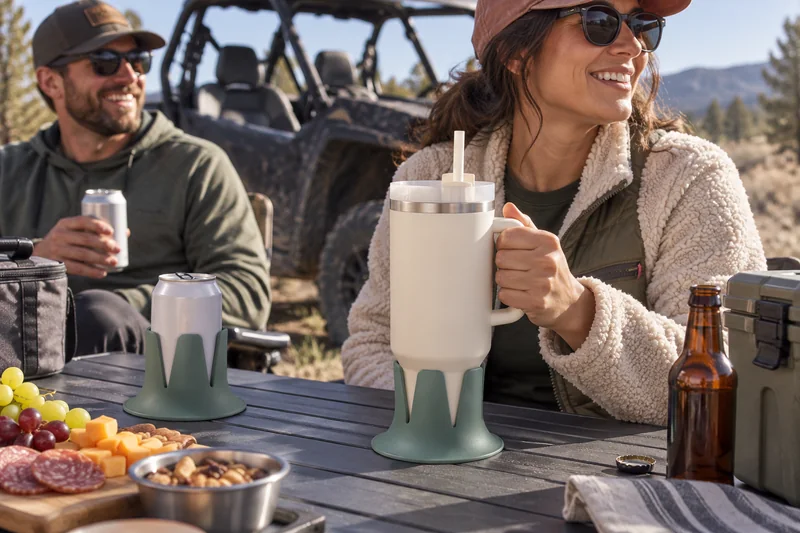
A base wide enough to spread its own footprint sidesteps that instead of trying to win it. Set on a ribbed bed, a domed cooler lid, or a tilted dash, a wide flexible base spreads its grip across whatever's underneath it instead of balancing on one high point, and flexible fins close around the bottom inch of whatever's set into it — a can, a colster, a 40 oz tumbler — holding from every side instead of depending on a rigid wall shaped to one exact width. It resists tipping through washboard and whoops, and when a hard hit does rock it, it settles back level instead of staying tipped.

None of that needs the cage to supply a tube size or the console to supply a deeper pocket. It just sits on whatever surface the moment calls for — console, dash, bed, cooler lid, or tailgate — and holds steady there.

None of that depends on your machine's tube diameter, its console shape, or which model year it is — just a base wide enough to hold its ground wherever the ride sets it down.

Get one — ships free

The buy button goes to steadilabs.com — Steadi Labs makes it.